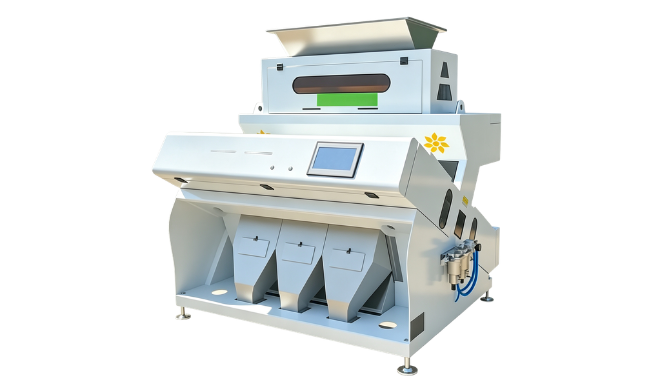


Rice Graders That Separate Whole from Broken

Goldilocks white rice graders sort milled rice by grain size, so whole kernels, normal rice, large broken and small broken leave the machine as separate streams. The grading happens on sieve decks with different hole diameters: the larger kernels ride above the screen while the broken pieces fall through to the next layer. Every series in the Goldilocks range uses this principle differently. The MMJP-A is a compact bracing-bar grader for small mills, the MMJP-B uses a flat rotating deck with automatic grading, the MMJM adds three motion trajectories and adjustable speed, the MMJX-B carries four spring-brace sieve layers, and the MMJM5+1 puts five sieving surfaces to work for 4 to 12 tons per hour. Grading is the step that turns a bag of mixed rice into graded, sellable product. Choose the Goldilocks grader that fits your line, and the whole mill earns more from the same paddy.

Rice Grader That Raises Whole Rice Yield

Graded rice sells for more than mixed rice, and a good grader is the machine that makes the difference. When a mill grades its output into whole rice, normal rice and broken fractions, the whole kernels can be sold at the premium grade, the broken rice goes to its own market, and nothing valuable is wasted inside a mixed bag. Goldilocks builds the grader range for exactly this job: MMJP-A and MMJP-B for steady small and medium grading, MMJM with its three trajectories and adjustable speed for fine separation, MMJX-B with four spring-brace layers for heavy-duty sorting, and MMJM5+1 for 4 to 12 tons per hour. The screens are standard items ordered by model number, and the machines are easy to set, clean and maintain. Ask for our grader catalog and compare the capacity, power and dimension sheets yourself. Grading is not an extra step; it is the step that pays for the machine.

Featured Products

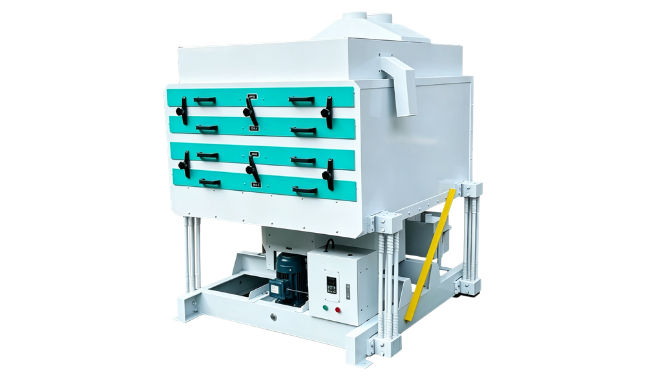
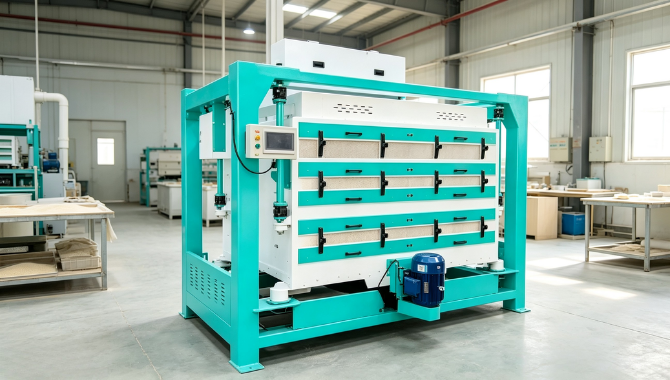
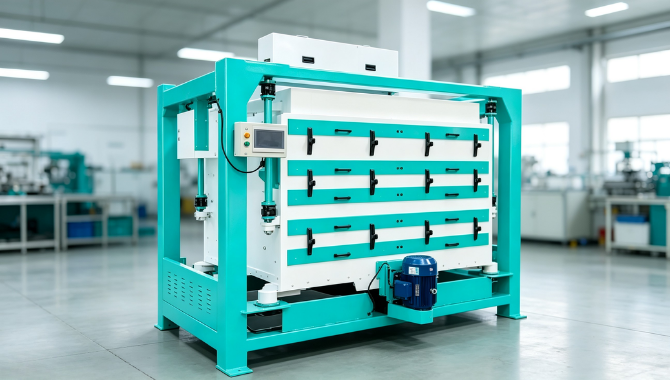
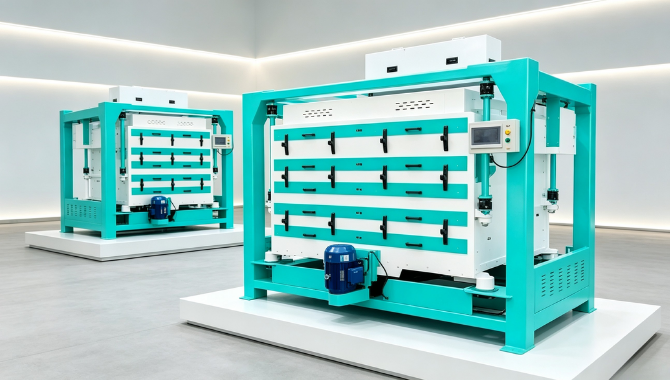
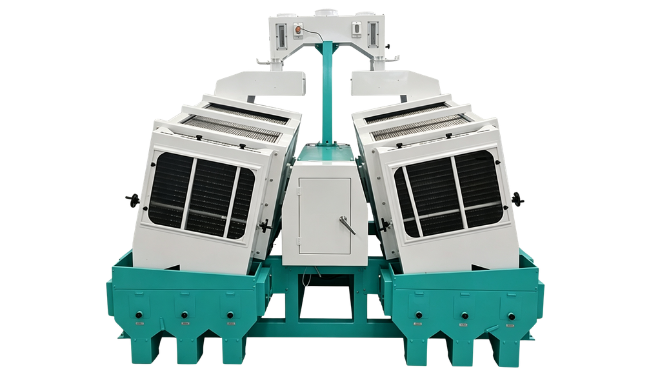
The MMJX-B series rice grader is a new type of grading equipment with a spring brace bar structure. It takes advantage of the difference in the size of rice particles and separates complete rice, normal rice, large broken and small broken through continuous sieving on four layers of round hole sieve plates with different diameters. The series includes the MMJX-B120x(4+1) and MMJX-B150x(4+1), grading 5 to 8 tons per hour on 1.1 to 2.2 kilowatts. The spring brace design gives the deck a steady, even motion, suiting medium and large mills and complete lines that need heavy-duty grading at 5 to 8 tons per hour.
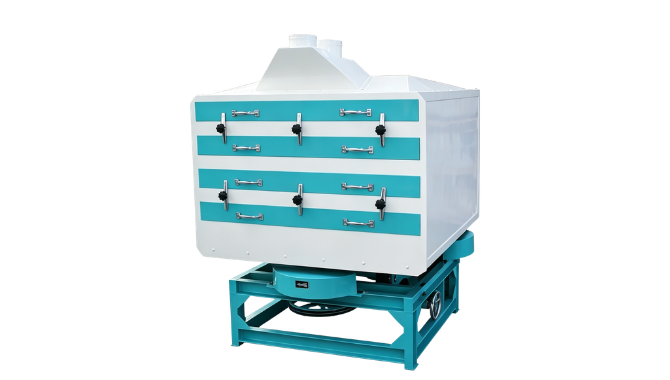
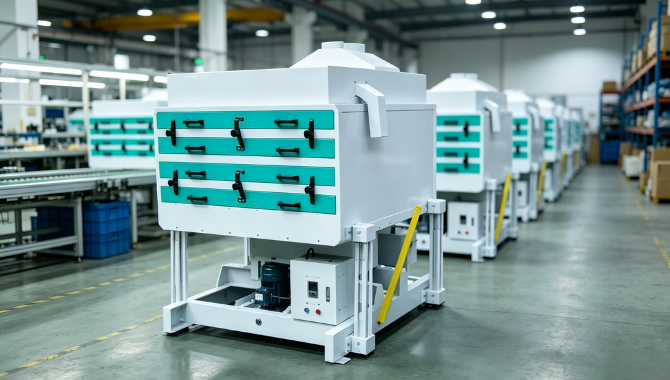
The MMJP-B series flat rotating rice grader uses the difference in grain shape between broken and whole rice, performing multiple rotations on a flat rotating screen, with frictional advancement forming automatic grading. Equipment with three or four layers adopts a continuous two to three times extraction process of whole rice, giving better grading effects. The series covers five models, from the MMJP-B 80×3 to the MMJP-B 150×4, grading 1.5 to 6 tons per hour on just 1.1 to 1.5 kilowatts. The machine runs steadily, screens change easily, and it suits 15 to 50 ton medium mills as the dependable grading stage between the whitener and the packer.
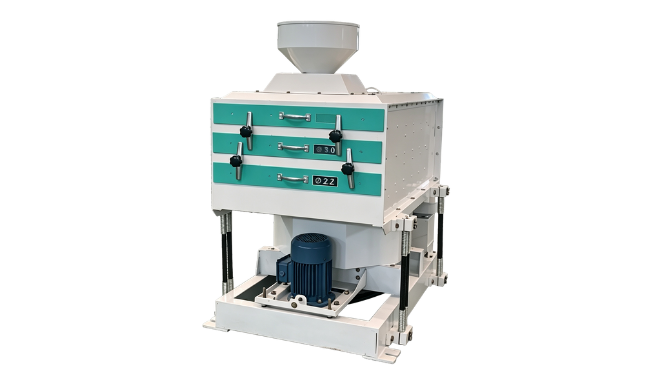
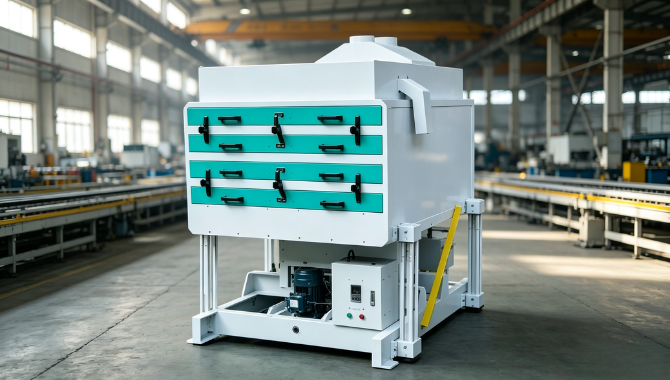
The MMJP-A series bracing-bar rice grader is mainly used for white rice grading in rice milling factories. It utilizes the difference in the size of milled rice, passing it through sieve plates with different hole diameters in continuous sieving to separate whole rice, normal rice, large broken and small broken. The series includes the MMJP-A 50×2 and MMJP-A 63×3, grading 0.8 to 1.25 tons per hour on 0.37 to 0.75 kilowatts. The compact structure takes little floor space and suits small mills and compact complete lines, with screens supplied as standard parts ordered by model number.
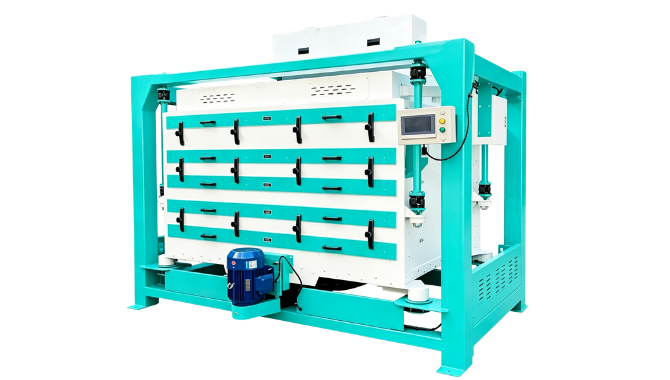
The MMJM5+1 rotary rice grader is mainly used for grading white rice, and it can also grade other granular products. By improving the process flow of the sieve body, the machine effectively uses five layers of sieving area to sieve the general rice and secure both the grading effect and the output. The series includes the MMJM125x5+1, MMJM160x5+1 and MMJM200x5+1, grading 4 to 12 tons per hour with air volumes of 4000 to 9000 cubic meters per hour on 2.2 to 3.0 kilowatts. It suits 100 to 200 ton large lines and multi-grain plants as the workhorse grader for high output.
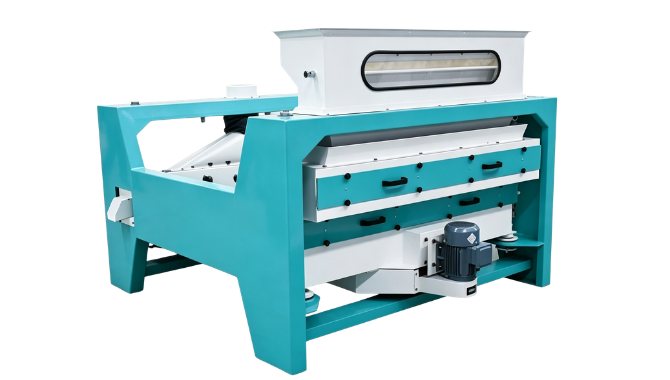
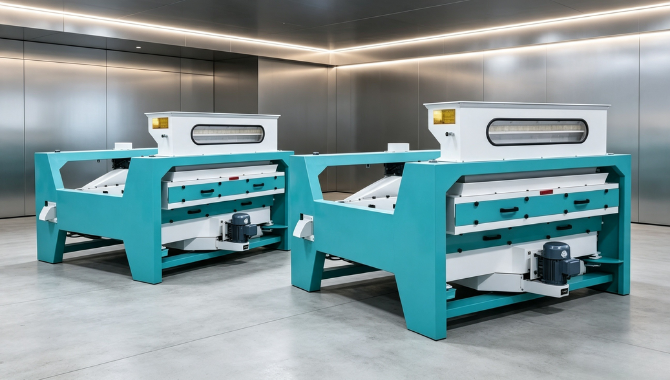
The MMJM series white rice grader generates three trajectories at once: the feeding end moves elliptically, the middle moves roundly, and after a small ellipse it settles into nearly linear reciprocating motion at the discharge end. It also has a unique sieve surface configuration, an effective feeding and bran-sucking cooling device, and adjustable speed, achieving fast and efficient grading. The series includes four models, from the MMJM100 to the MMJM180, grading 3 to 6.5 tons per hour on 0.75 to 1.1 kilowatts, with weights from 700 to 1050 kilograms. It suits medium and large mills that want fine separation with adjustable effect.

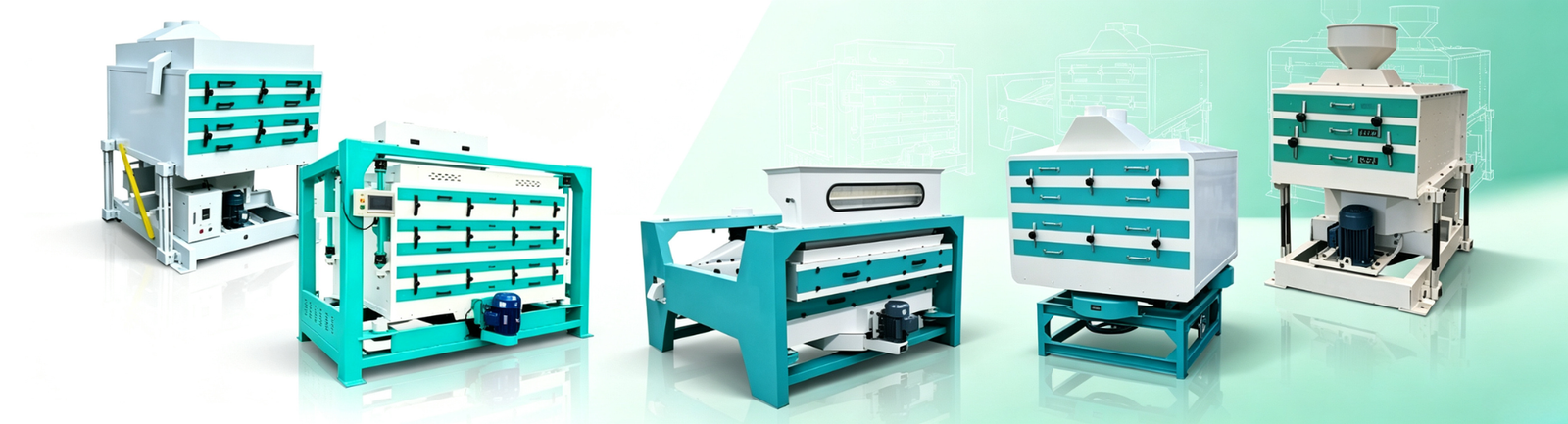
The Goldilocks white rice grader series covers the full capacity range from 0.8 to 12 tons per hour in five branches: the bracing-bar MMJP-A, the flat rotating MMJP-B, the three-trajectory adjustable-speed MMJM, the four-layer spring-brace MMJX-B and the five-surface MMJM5+1. The whole series separates whole rice, normal rice, large broken and small broken by grain size and shape, with screens supplied as standard parts ordered by model number. From a small village mill to a 200 ton complete line, every plant can find a matching size in the same catalog, with factory-direct supply, published specifications and responsive after-sales support.

Rice Grader for Graded, Saleable White Rice
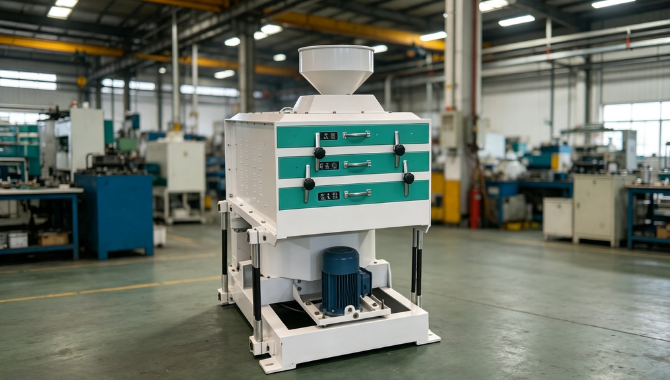
The white rice grader is the machine that sorts milled rice by grain size, and Goldilocks builds the series for mills that want to sell graded product instead of mixed bags. The principle is simple: milled rice moves across layered sieve screens with different hole diameters, the larger kernels ride above the screen, and the broken pieces fall through to the next layer. By the end of the travel, whole rice, normal rice, large broken and small broken have separated into different outlets. The Goldilocks range covers five branches with different motion designs: the bracing-bar MMJP-A, the flat rotating MMJP-B, the three-trajectory MMJM, the spring-brace MMJX-B and the five-surface MMJM5+1. Capacities run from 0.8 to 12 tons per hour, with published power and dimensions for every model. Screens are standard parts ordered by model number, and the machines are simple to set and easy to clean. For a mill that wants better prices and cleaner product, a Goldilocks rice grader is the step that pays. The screens are easy to inspect, and changing one takes minutes, not hours.

Broken Rice Separation That Protects Your Price

Broken rice is not a loss; it is a different product. But broken rice inside the whole-rice bag is a real loss, because the whole bag sells at the broken-rice price. A rice grader solves this by separating the fractions at the end of the line: whole kernels go to the premium market, large broken and small broken go to their own buyers, and every fraction is sold at its own price. Goldilocks designs its grader screens for clean separation, with hole diameters matched to the rice varieties the mill processes. The MMJP-A and MMJP-B use proven rotating and bracing designs for steady small and medium grading, the MMJM separates more finely with three trajectories and adjustable speed, and the MMJX-B and MMJM5+1 carry the big tonnage of larger plants. Because the screens are standard parts, a mill can change the cut by changing a screen, and order the new one by model number. Clean separation is the quiet difference between selling mixed rice and selling graded rice. That is why mills that grade their output sell the same paddy for more, and why the grader pays for itself faster than any other machine in the line.

How to Choose the Right Rice Grader Size
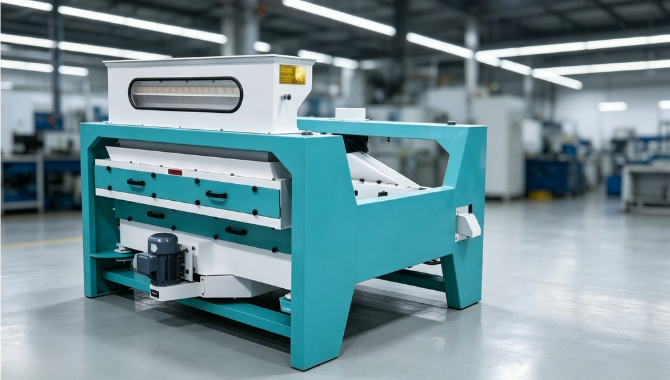
Choosing a rice grader starts with the whitening output it has to follow. If your mill produces about one ton of white rice per hour, the MMJP-A 63×3 at 1.25 tons per hour gives you a comfortable match. At two tons per hour of output, the MMJP-B 80×4 or 100×4 covers you with margin. At three to four tons, the MMJM125 or MMJP-B 125×4 fit; at five to six tons, the MMJM150 or MMJX-B120 come into range. For lines producing eight tons or more, the MMJM5+1 series, from 4 to 12 tons per hour, is the practical answer. The second question is floor space: every Goldilocks model has published dimensions, so you can check the mill room before ordering. The third question is the rice varieties you grade; different grain shapes need different screen diameters, and the factory can advise on screen selection. Finally, think about growth. Because all five branches share one parts system, you can step up to a larger grader later without changing your spare parts routine. Published capacity, honest dimensions and a factory that advises: that is the Goldilocks way. A quick call with the factory settles most sizing questions before you commit.

Rice Graders Built for Growing Markets

Mills in Africa, Southeast Asia and South Asia are expanding fast, and their customers increasingly demand graded rice rather than a mixed bag. Goldilocks designs its grader range for these markets: simple operation, standard screens and honest published specifications. The MMJP-A is compact enough for a small mill room and grades 0.8 to 1.25 tons per hour; the MMJP-B brings flat rotating grading to 1.5 to 6 tons per hour; and the MMJM, MMJX-B and MMJM5+1 carry the larger plants. New operators learn the basics in a day, and the standard parts list means local support is enough for most service needs. The machines handle the mixed paddy that arrives from many small farms, because the grading is by grain size and the screens can be selected for the local varieties. Our factory has shipped graders to mills across Africa, South America and Central Asia, and supports them with manuals, parts lists and video guidance. For a growing market that needs graded, sellable rice, Goldilocks offers graders that start easily and keep running. Most of these mills run on simple power and limited workshop support, so the machines are built to be tolerant: steady feeders, protected motors and screens that do not bend under load.

MMJP-B Flat Rotating Grader for Steady Grading
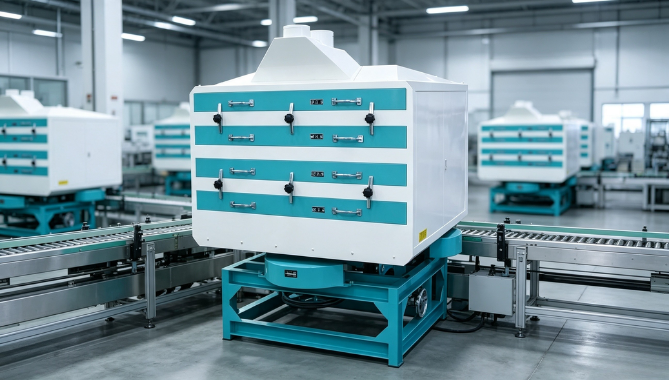
The MMJP-B series is the flat rotating rice grader of the Goldilocks range, covering 1.5 to 6 tons per hour across five models. It uses the difference in grain shape between broken and whole rice: the material circles on a flat rotating screen, frictional advancement forms automatic grading, and three or four layer machines take the whole rice out in two or three continuous passes, which improves the grading effect. The series starts with the MMJP-B 80×3 at 1.5 to 2 tons per hour on 1.1 kilowatts and runs to the MMJP-B 150×4 at 5 to 6 tons per hour on 1.5 kilowatts, with the 80×4, 100×4 and 125×4 in between. Every model runs on the same modest power, because the grading motion does the work rather than brute force. The frames are compact, the screens are standard parts, and the machine is simple to set for different rice varieties. For mills that want a proven, steady grader between the whitener and the packing line, the MMJP-B series is the dependable middle of the Goldilocks range. Operators like the MMJP-B because the grading does not need constant watching: once the feed is set, the machine holds its separation through the shift, and the modest power keeps the running cost low even on a long production day. For mills that run two shifts, that steady behavior is worth more than any extra feature.

MMJM5+1 Grader That Uses Five Sieving Surfaces

When a mill outgrows the standard grader, the answer is more sieving area in the same floor space. The MMJM5+1 series achieves this by improving the process flow of the sieve body and effectively using five layers of sieving area to sieve the general rice, which secures both the grading effect and the output. The machine is mainly used for grading white rice, and it can also grade other granular products, which makes it useful for plants that handle multiple grains. The series offers three models: the MMJM125x5+1 grades 4 to 6 tons per hour with an air volume of 4000 cubic meters per hour on 2.2 kilowatts; the MMJM160x5+1 grades 8 to 10 tons per hour with 6000 cubic meters per hour on 2.2 kilowatts; and the MMJM200x5+1 grades 10 to 12 tons per hour with 9000 cubic meters per hour on 3.0 kilowatts.
The larger air volumes carry away bran and dust during grading, keeping the product clean. For large mills and complete 100 to 200 ton lines, the MMJM5+1 is the high-capacity grader that keeps the whole plant moving. The five-surface design is the practical answer to a common problem: the mill has grown, the line produces more, and the old grader cannot keep up without another machine beside it. With the MMJM5+1, the same floor area carries more sieving surface, so the expansion happens in the machine, not in the building. The grading effect on general rice is consistent, which keeps the downstream packing line steady through the day.

A Grader That Matches Your Whitener and Packer
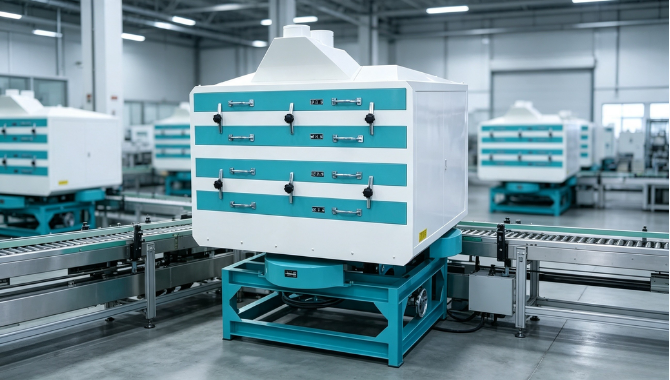
A grader sits between the whitener and the packing line, and it has to match both. If the grader is smaller than the whitener output, rice backs up and the line slows; if it is larger than the packing capacity, floor space is wasted. Goldilocks publishes the capacity of every grader model, and the factory sizes the machine against the whitener when it quotes a line. The MMJP-A series fits lines producing up to about 1.25 tons per hour; the MMJP-B covers 1.5 to 6 tons; the MMJM covers 3 to 6.5 tons; the MMJX-B covers 5 to 8 tons; and the MMJM5+1 covers 4 to 12 tons. Because the same factory builds the cleaner, husker, separator, mill, grader and elevator, the whole chain can be balanced on paper before anything is ordered.
When a customer already has a line from other suppliers, the factory can still advise on the right grader by asking about the whitening capacity and the bagging rate. Matching is not a slogan at Goldilocks; it is a selection step in every quotation. The result is a line that runs without bottlenecks from the first day. The factory asks three questions before it recommends a grader: what the whitener produces per hour, how many bags the packing line can take, and which rice varieties are graded most often. With those three numbers, the selection is a matter of the published table rather than a guess, and the quotation names the exact model and its screens. When the line later grows, the same three questions produce the next size, and the mill keeps its parts routine and its supplier.


More Features for Products

Goldilocks builds the grader family in five branches so a mill can pick the exact size instead of stretching a small machine or wasting space on a big one. The MMJP-A 50×2 and 63×3 cover 0.8 to 1.25 tons per hour for small mills. The MMJP-B 80×3 to 150×4 cover 1.5 to 6 tons per hour for medium plants. The MMJM100 to MMJM180 cover 3 to 6.5 tons per hour with fine adjustment. The MMJX-B120 and MMJX-B150 carry 5 to 8 tons per hour on four layers. The MMJM125x5+1 to MMJM200x5+1 grade 4 to 12 tons per hour for the largest lines. Every model shares the same operating principle, the same screen system and the same factory support, so a mill that starts small can step up without learning a new machine. Published capacity, power, dimensions and weight for every model make selection honest and simple. One family, one parts list, one supplier, and a size for every mill. Whatever your daily tonnage, there is a Goldilocks model sized for it, and the factory will help you pick it.
The sieve screen is the only part of a grader that touches the rice, and it is the part that wears. Goldilocks makes every screen a standard part with its own model number, which changes the economics of maintenance. When the holes wear or the variety changes, the mill orders the same number, the new screen fits the frame without modification, and the change takes a short stoppage rather than a rebuild. The same discipline covers the rest of the machine: springs, brace bars, eccentric drives, bearings and feed devices are all listed in the parts manual that ships with every grader. Routine maintenance is short: check the motion, keep the screens clean, inspect the springs. The MMJP-A even keeps its structure simple for small mills with limited workshop support. Because the factory holds the drawings, parts for machines sold years ago remain available. A grader with standard screens and a clear parts list is a machine a mill can afford to run for years. Maintenance is short, costs are predictable, and the mill keeps its own spare screens on the shelf.

Technical Parameters

ModelCapacity (t/h)Power (kW)Dimension (L×W×H mm)
MMJX-B 120×(4+1)5-61.11650×1455×1865
MMJX-B 150×(4+1)6-82.21950×1755×1955
ModelCapacity (t/h)Power (kW)Dimension (L×W×H mm)
MMJP-B 80×31.5-2.01.11600×1000×1315
MMJP-B 80×41.5-2.01.11600×1000×1410
MMJP-B 100×42.0-2.51.11690×1090×1410
MMJP-B 125×43.0-4.01.11690×1460×1410
MMJP-B 150×45.0-6.01.51690×1590×1560
ModelCapacity (t/h)Power (kW)Dimension (L×W×H mm)
MMJP-A 50×20.80.37900×600×980
MMJP-A 63×31.250.751200×740×1250
ModelCapacity (t/h)Air volume (m³/h)Power (kW)Dimension (L×W×H mm)
MMJM125×(5+1)4-640002.22270×2060×2560
MMJM160×(5+1)8-1060002.22270×2410×2560
MMJM200×(5+1)10-1290003.02270×2810×2610
ModelCapacity (t/h)Power (kW)Weight (kg)Dimension (L×W×H mm)
MMJM1003~3.50.757002020×1400×1460
MMJM1254~4.50.758002020×1650×1460
MMJM1505~5.51.19002020×1900×1780
MMJM1806~6.51.110502020×2400×1800
Rice Grader Series from 0.8 to 12 Tons per Hour
One grader cannot serve every mill, so Goldilocks builds the rice grader series in five branches. The MMJP-A 50×2 and 63×3 grade 0.8 to 1.25 tons per hour for small mills and compact lines. The MMJP-B 80×3 to 150×4 cover 1.5 to 6 tons per hour with flat rotating decks and automatic grading. The MMJM100 to MMJM180 handle 3 to 6.5 tons per hour with three motion trajectories and adjustable speed. The MMJX-B120 and MMJX-B150 carry 5 to 8 tons per hour on four spring-brace layers. At the top, the MMJM125x5+1 to MMJM200x5+1 grade 4 to 12 tons per hour using five sieving surfaces. All five branches share one operating principle, one parts system and one factory catalog, so a mill can grow from a small grader to a large one without changing supplier. Whatever your line size, there is a Goldilocks grader sized for it, with published specifications and factory-direct supply.
  • “We added the MMJP-A 63×3 last season. Now the shop buys whole rice from us at the top grade instead of mixed. The screens are easy to change, and the machine has not missed a day. Worth every dollar. Our customers noticed the difference in the first week.”
  • “Our MMJP-B 100×4 runs behind two MNMS whiteners, and it keeps up fine. Grading is clean, power use is low, and the screens were easy to order by the numbers in the manual. Support answered my setup questions by video the same day. No complaints since. Best purchase in years.”
  • “I compared grader specs from three factories before buying the MMJM150. The motion design is different from what I knew, and the separation is noticeably better. Low power, quiet running, and the mill room stays cleaner now. The adjustable speed helps when the rice changes. I would buy the same model again.”
  • “Imported the MMJX-B120 for a client’s new line. Packing was solid, the manual matched the machine, and it started without any factory visit. We have already recommended Goldilocks to two other buyers. The buyer asked for the same brand on his second line. Documentation was clear, start-up was smooth. No issues in six months.”

Alternative Names

rice grader / rice grading machine / white rice grader / rice grader machine / rice sorter / broken rice separator / rice grading sieve / rice grader price / rice grader manufacturer / rice mill grader / automatic rice grader / rice grader for sale / rice grading machine price / rice grader machine for sale / rice sieve machine / paddy rice grader / rice grader supplier / rice grading equipment / rice grader factory / rice grader exporter / white rice sorter / broken rice remover / rice grading plant / rice grader machine price / rice classification machine / rice size grader / rice grader machine manufacturer / grain grader machine / rice cleaning and grading / rice grader for rice mill / rice grading system / commercial rice grader / industrial rice grader / rice grader capacity / rice grader spare parts / rice grader in China / rice mill equipment grader / rice length grader / rice thickness grader / rice grader wholesale / rice grader machine supplier / grain sifting machine / rotary rice grader / rice grader price list / small rice grader / rice grader machine for business / automatic rice grading line / rice grader after-sales / rice grader installation / rice quality grader / rice milling grader / rice grader for Africa / rice grader for Asia / rice grading screen / high capacity rice grader / rice grader motor / rice grader design / rice grader catalog / rice grader 5 layers / rice grader 4 layers
Send Your Inquiry Now
en_USEnglish
滚动至顶部