


From Paddy to Packed Rice, One Complete Line
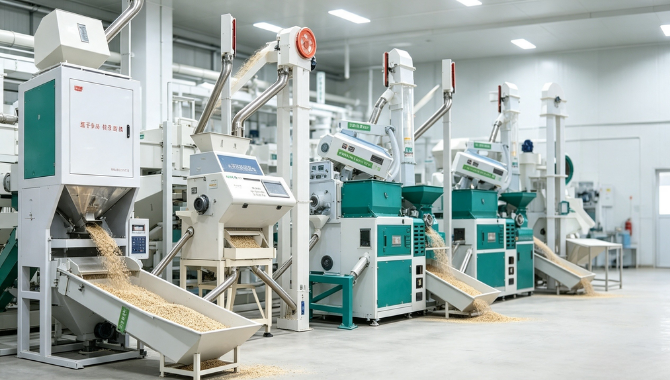
A complete rice production line takes paddy in at one end and delivers bagged white rice at the other. Goldilocks builds complete lines from 20 to 200 tons per day, covering every stage: paddy cleaning, destoning, husking, paddy separation, whitening, grading, polishing, color sorting and packing, with elevators connecting each step. The CTNM20-25 line handles 20 tons a day and suits a first-time mill owner. The CTNM30-40 and CTNM50-60 lines step up to 30 to 60 tons for growing businesses, and the CTNM80-200 line serves large commercial mills. Every line is assembled from Goldilocks machines matched at the factory, so the stages run in balance from the first day. All components are built in the same plant in Hunan, China, under ISO9001:2015 quality management. Tell us your daily paddy supply and your market, and we will recommend the line size and configuration that fits.
A Complete Rice Line for Every Mill Size
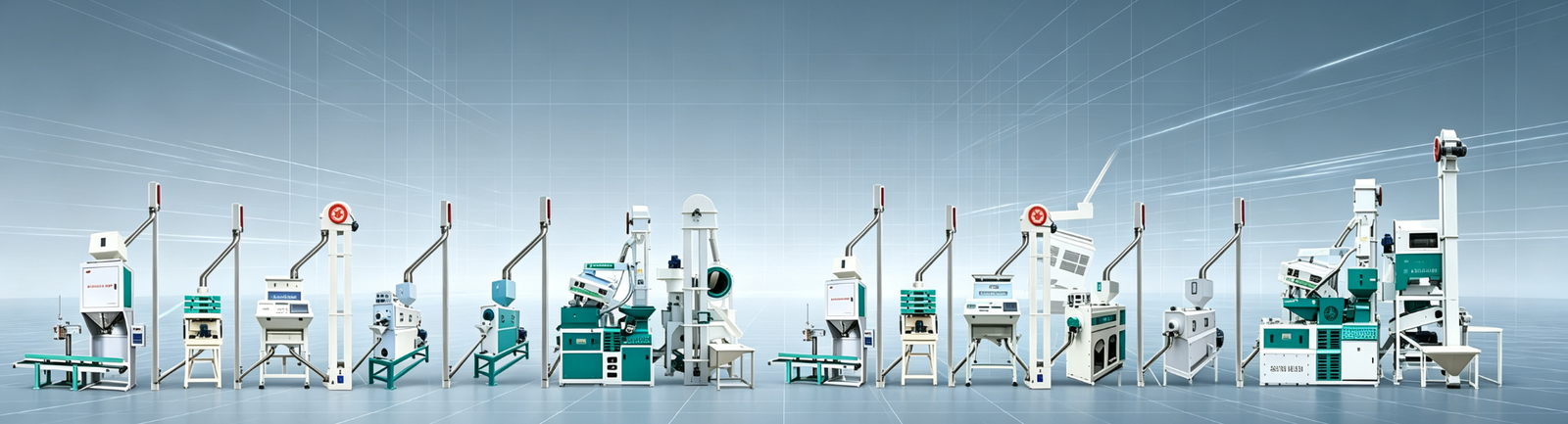
Rice mills grow at different speeds, and Goldilocks builds a complete line for each stage. A mill processing around 20 tons of paddy a day gets the CTNM20-25, a compact line that cleans, husks, separates, whitens, grades and elevates in one flow, with room to add polishing, color sorting and packing later. A mill at 30 to 40 tons a day moves to the CTNM30-40, described in the factory catalog as the ideal model for small and medium rice processing factories. At 50 to 60 tons, the CTNM50-60 covers the whole process from paddy cleaning to white rice precision processing. And at 80 to 200 tons, the CTNM80-200 serves large commercial plants. All four series share the same component technology, so operators and spare parts carry over when you upgrade. Tell Goldilocks your current output and your plan for next year, and the right line is the one that grows with you.
Cloud-connected testing fleets will enable benchmarking across multiple factories and predictive maintenance scheduling. Augmented reality interfaces may simplify setup and troubleshooting for operators. For manufacturers, staying competitive means partnering with EOL testing suppliers who invest in ongoing R&D and can upgrade their systems as new lighting technologies emerge. Choosing a forward-thinking testing partner today ensures your quality control infrastructure remains capable and cost-effective as automotive lighting technology continues its rapid evolution over the coming decade.
Read More
Product Introduction
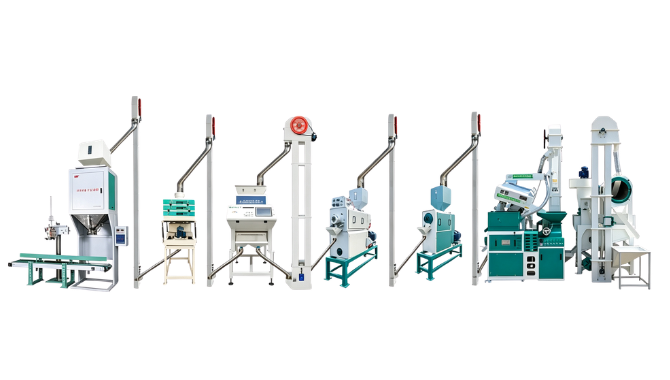
CTNM20-25 Complete set Rice Production Line
The CTNM20-25 is Goldilocks’ entry-level complete rice production line, processing 20 tons of paddy per day. It combines a 6LN-18/15SF combined rice milling machine with an MMJP-A 63×3 rice grader and TDTG18/07 elevators, covering cleaning, destoning, husking, paddy separation, whitening and grading in one flow. The A to E configurations add a rice mill, polisher, color sorter and packing scale step by step, so the mill grows without replacing the line. It suits a first mill, a village cooperative or a trader milling own stock.
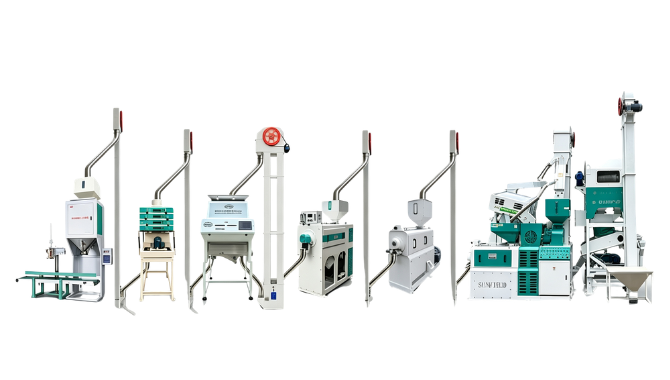
CTNM30-40 Complete set Rice Production Line
The CTNM30-40 complete rice production line processes 30 to 40 tons of paddy per day and is described in the Goldilocks catalog as the ideal model for small and medium rice processing factories. It uses a TQLQ70 combined cleaner and destoner, an MLGT20 rubber roller husker, an MGCZ80×7 gravity paddy separator, an MNMS16 rice mill and TDTG18/11 elevators. Graded configurations add a polisher, a color sorter and a packing scale, and low-speed W2 elevators handle the grain gently. It suits mills that outgrew a combined machine and now supply a town market plus wholesale buyers.
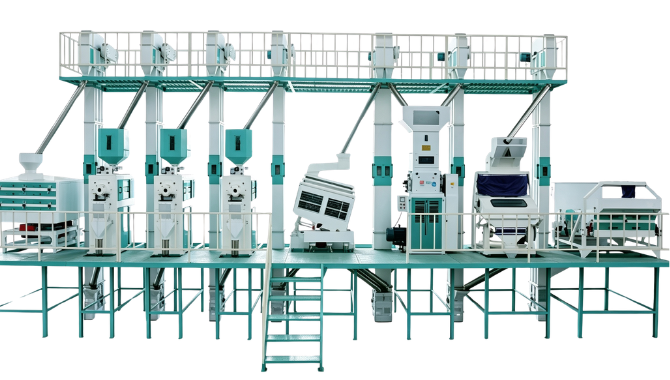
CTNM50-60 Complete set Rice Production Line
The CTNM50-60 complete rice production line covers the whole process from paddy cleaning to white rice precision processing at 50 to 60 tons per day. The machine list includes a TQLZ80 cleaning screen, TQSX80 destoner, HU10 husker, MGCZ100×10 paddy separator, MNMS18 rice mill, MMJP-B 100×4 grader, MPGW100 polisher, 6SXM-256 color sorter, DCS-50A packing scale and TDTG24/18 elevators with W4 low-speed units. It suits commercial mills supplying town markets, wholesalers and export buyers that need consistent volume and quality.
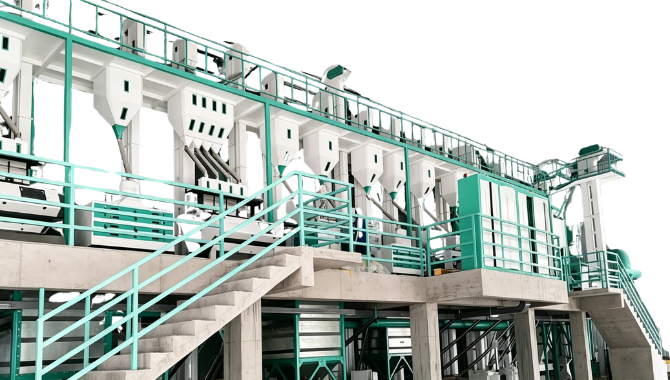
CTNM80-200 Complete set Rice Production Line
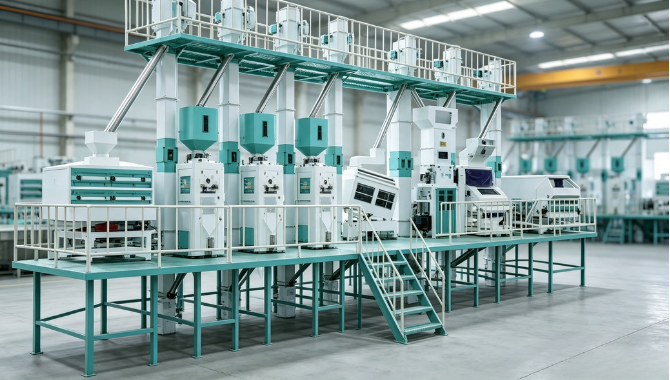
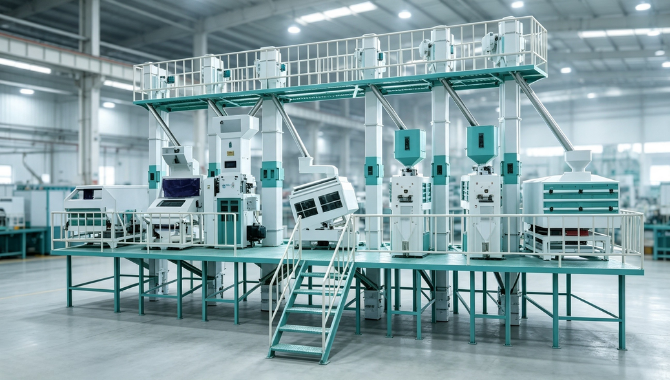
The CTNM80-200 series serves large commercial rice plants at 80 to 200 tons of paddy per day. It is planned as a complete project: the machine list, layout, elevator routing and building requirements are worked out with the customer before production starts. The line is built from the same component family as the smaller CTNM series, so operators, spare parts and maintenance habits stay consistent across a company that owns several plants. It suits export-oriented mills, industrial processors and investor-built plants that buy paddy by the season and ship rice by the container.
What a Complete Rice Production Line Actually Includes
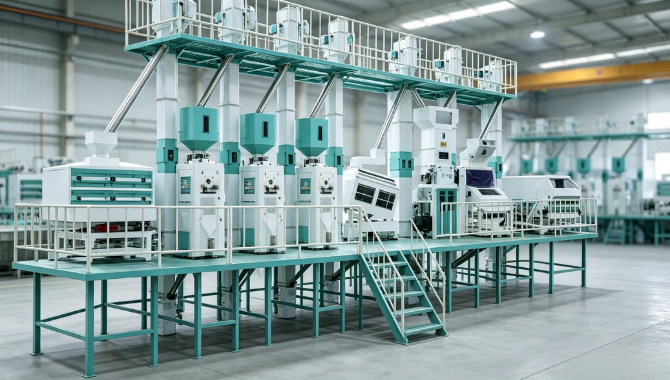
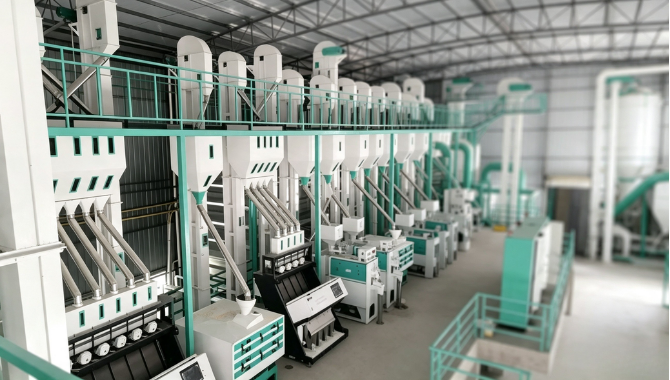
A complete rice production line is a connected set of machines that turns paddy into packed white rice in one continuous process. It starts with cleaning and destoning, moves through husking and paddy separation, then whitening, grading, polishing, color sorting and packing, with elevators carrying the grain between stages. Goldilocks builds four series of complete lines. The CTNM20-25 handles 20 tons of paddy per day and suits a first mill. The CTNM30-40 steps up to 30 to 40 tons and is described in the factory catalog as the ideal model for small and medium rice processing factories. The CTNM50-60 covers 50 to 60 tons a day through the full process from paddy cleaning to white rice precision processing. The CTNM80-200 serves large commercial mills at 80 to 200 tons. Every machine in these lines is built by Goldilocks in one factory, matched at the design stage, and supported by one spare parts source. For a mill owner, the line replaces a room of uncoordinated single machines with one balanced process.
How to Choose Between a 20 TPD and a 200 TPD Rice Line
Capacity is the first decision in a rice mill project, and Goldilocks sizes the line to the paddy supply, not to the dream. The CTNM20-25 processes 20 tons of paddy a day, which fits a mill receiving a few truckloads of paddy each day from local farmers. The CTNM30-40 handles 30 to 40 tons and matches a mill that buys from several villages or a small trader network. The CTNM50-60 takes 50 to 60 tons a day, a scale that supports a town market plus a small wholesale customer base. The CTNM80-200 reaches 80 to 200 tons and belongs to commercial plants that buy paddy by the season and ship rice by the container. The rule is simple: the line should finish the day’s paddy in a normal working day, with a little spare capacity for the harvest peak. Oversized lines sit idle and burn electricity; undersized lines lose customers when they cannot deliver. Goldilocks asks for your harvest schedule, storage capacity and daily target before recommending a series. The same question decides the building size, the power connection and the number of operators you will need. Storage matters too: a warehouse lets the line run steadily through the harvest peak instead of chasing the trucks.
Why Cleaning and Destoning Decide the Whole Line's Output
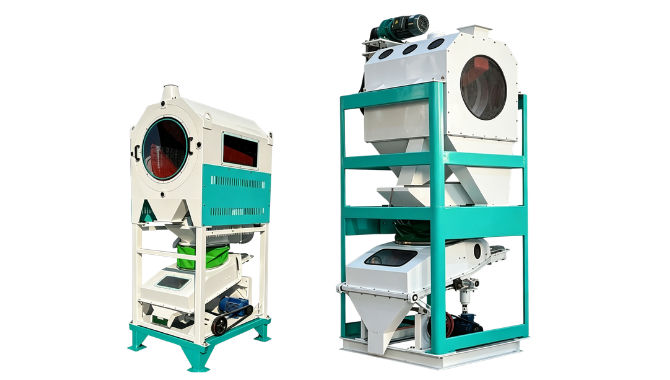
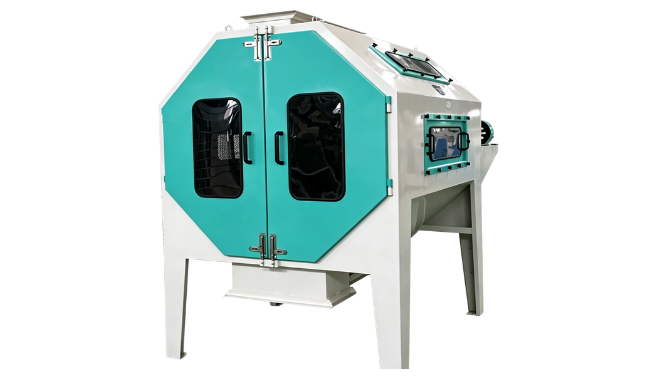
Every stage of a complete rice line depends on the grain that enters it, which is why the line begins with cleaning and destoning. Paddy from the field carries straw, dust, weed seeds, stones and sometimes metal; if these pass downstream, they wear the rubber rollers, scratch the emery rollers, block the screens and end up in the finished rice. On the CTNM20-25 line, cleaning starts with a combined cleaner and destoner; on the CTNM30-40 it uses a TQLQ70 combined cleaner and destoner; and on the CTNM50-60 the line separates the two jobs with a TQLZ80 cleaning screen and a TQSX80 suction destoner. These machines remove big and small impurities by screening and separate stones by specific gravity with a controlled air flow. The result is clean, even paddy entering the husker, which protects every machine behind it.
For millers, the cleaning stage is also where dust control starts: the machines run with dust collection, so the mill stays cleaner and the working conditions improve. Goldilocks matches the cleaning capacity to the line output, so the stage never becomes a bottleneck at harvest time, when the paddy carries the most field trash. The destoner on the larger lines is a suction design, removing stones by air and vibration without adding much power. Screens are quick to change, so the cleaning stage adapts to paddy from different farms in the same day.
Rubber Roller Husking in the Complete Line: Fast and Gentle
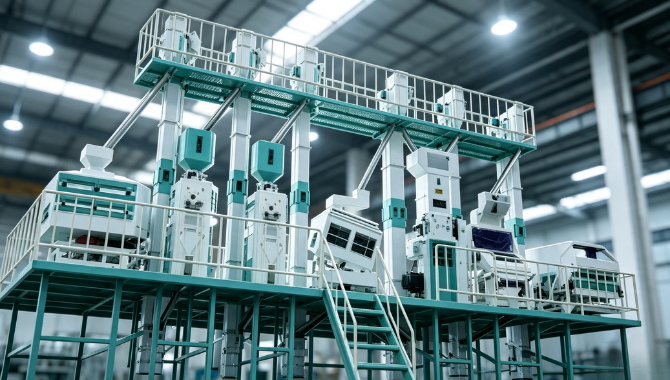
Husking is where the paddy loses its outer hull, and the complete line makes this stage work at high volume. The CTNM30-40 line uses an MLGT20 rubber roller husker, the CTNM50-60 uses the HU10 husker, and both are gearless designs with hexagonal belt drive, which means no gearbox oil leaks and fewer parts to maintain. Two rubber rollers turn toward each other at different speeds; the paddy passes between them and the hull is pulled off while the brown rice kernel stays intact. The rubber surface gives slightly under pressure, so the grain is not crushed, which protects the milling rate before the whitening stage even starts. The catalog quotes a husking rate above 90 percent for the MLGT series, and the HU series adds stepless speed adjustment and a dedicated fan.
After husking, the mixture of brown rice, unhulled paddy and husk moves to the gravity paddy separator. Unhulled paddy is returned to the husker for another pass, and brown rice moves on to whitening. On a complete line, the husker is sized to the line output, so it keeps pace with the cleaners in front and the separator behind without pile-ups between machines. Roller wear is normal and the rollers are replaceable; each line ships with spare rollers, and replacements are ordered by model number. The factory sets the roller pressure before dispatch, and the manual explains the adjustment in plain steps. In markets where paddy arrives with high moisture, the husker handles the extra load without constant attention.
Rice Grading in the Line: One Product Becomes Three
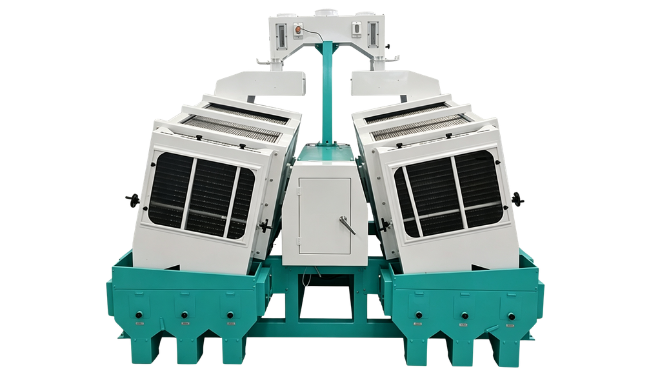
Milled rice is never one uniform stream; it always contains whole kernels, large broken pieces and small broken pieces. Grading separates them, and in a complete line this happens automatically at the right volume. The CTNM20-25 line uses an MMJP-A 63×3 rice grader, the CTNM30-40 line uses the SM5-50 or the MMJP-B 63×4, and the CTNM50-60 line uses an MMJP-B 100×4.
These graders work on the size difference between whole and broken rice: screens with different hole diameters separate the stream into whole rice, large broken and small broken fractions. The value of grading is easy to see in the accounts. Whole rice sells at the highest price, large broken sells at a lower rate to food processors, and small broken finds its own market in porridge mixes and animal feed. A mill that bags everything together sells the whole stream at the broken price; a mill that grades sells each fraction at its own market price. The graders on the Goldilocks lines are simple and robust, with screens that are quick to inspect and replace. Operators can change the sorting result by choosing different screen specs, depending on what the local market wants. Because grading sits between whitening and the packing stage, it also protects the final appearance: the bags that leave the mill contain clean whole rice, which builds a regular customer base. Grading also prepares the rice for the packing stage, where a clean grade means consistent bags. For most markets the grader in the line is enough; mills that want a stricter split can add a length classifier later. The screens are easy to change, and the grader shares the line’s drive, so it adds little to the power bill. Mills usually adjust the screen set once a season, when the paddy variety changes.
What Happens When a Complete Rice Line Arrives at Your Site
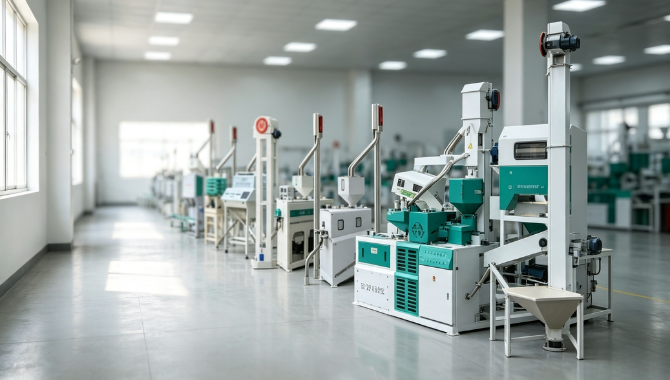
Ordering a complete rice line is the beginning of a project, and the weeks between arrival and the first bag of packed rice decide how fast the investment pays back. Goldilocks prepares for that period before the line ships. Every line leaves the factory with a layout plan, installation drawings for each machine, operator manuals and a standard spare parts kit. The layout plan shows where each machine stands, where the elevators run and where the operator works; the buyer checks it against the building before the container arrives, so the concrete, the power points and the headroom are ready on day one.
When the machines arrive, they are unloaded by machine number, and the packing list matches every crate. Assembly follows the layout: the machines are leveled, the elevators are aligned, the power is wired, and the air and water supplies for the polisher and the sorter are connected. Most buyers do this with their own mechanics, guided by the drawings and by video calls with the Goldilocks team; the factory stays available during commissioning and answers within a day. The first test run is done with a small batch of paddy, checking each stage before the line goes to full speed. After start-up, the mill runs a normal shift and watches three numbers: the milling rate, the broken rate and the packed weight accuracy. Goldilocks supports this phase for every line size, from the CTNM20-25 to the CTNM80-200. Most lines are producing saleable rice within two to three weeks of arrival, and the ones that go faster are the ones where the building work was finished before the container arrived. The commissioning week also includes training: the Goldilocks team walks the operators through the feed gates, the roller adjustment, the separator air control, the polisher water flow and the sorter programs, so the local crew can run the line without depending on the factory. The manuals stay on site, and the video calls are recorded for the operators to watch again.
Most mills run the first week at half speed, checking the milling rate and the packed weight, then increase to full speed when the numbers hold. The factory asks for the first week’s numbers and compares them with the test records, which catches small problems early. If a part is damaged in shipping, the claim is handled with photos and a replacement ships quickly. Goldilocks keeps the order file for years, so a mill that expands later can order matching machines and know they will fit the existing line. That long-term consistency is part of why buyers return.
More Features for Products
A complete line does not have to be bought complete. Goldilocks publishes the A to E configurations for the CTNM20-25 and CTNM30-40 lines, so a mill buys only the stages it can use today. Configuration A is the core line: cleaning, husking, separation, whitening, grading and elevating. Configuration B adds a rice mill for extra whitening capacity. Configuration C adds a polisher for a glossy finish. Configuration D adds a color sorter for uniform appearance. Configuration E adds a packing scale, so the line delivers retail-ready bags. Each stage connects to the existing line with the machines Goldilocks already builds, and the elevators and building stay in place. The advantage is financial as much as technical: the mill invests in what earns today, learns the market, and adds the next stage with the profit from the previous one. It also protects the mill from overbuilding, because a line bought at full specification sits idle when the paddy supply is still growing. For a first-time buyer, the graded configurations turn a large project into a series of small, affordable steps, each one adding value to the finished rice.
Goldilocks builds complete rice lines at every practical capacity, and the buyer chooses the size, not a compromise. The CTNM20-25 processes 20 tons of paddy a day, the CTNM30-40 processes 30 to 40 tons, the CTNM50-60 processes 50 to 60 tons, and the CTNM80-200 reaches 80 to 200 tons. Because all four series share the same component technology, the buyer’s choice is about scale, not about different machines with different habits. The cleaning, husking, separation, milling and grading principles are identical across the range; only the sizes change. This matters in three practical ways. First, a mill that outgrows its line stays with the same operator skills and the same spare parts system. Second, a company with several plants runs them with one maintenance team and one training program. Third, the factory’s field experience from hundreds of installed lines flows back into every size, so a 20 ton line benefits from what was learned on a 200 ton line. Capacity is the first question in any mill project, and the Goldilocks range answers it without gaps. Tell the factory your harvest pattern, and the line size follows.
Technical Parameters
| Model | CTNM20-25A | CTNM20-25B | CTNM20-25C | CTNM20-25D | CTNM20-25E |
|---|---|---|---|---|---|
| Output | 20 TPD | ||||
| Combined Rice Milling Machine | 6LN-18/15SF | 6LN-18/15SF | 6LN-18/15SF | 6LN-18/15SF | 6LN-18/15SF |
| Rice grader | MMJP-A 63*3 | MMJP-A 63*3 | MMJP-A 63*3 | MMJP-A 63*3 | MMJP-A 63*3 |
| Rice mill | / | MNMS15A | MNMS15A | MNMS15A | MNMS15A |
| Rice polisher | / | / | MPGW12.5 | MPGW12.5 | MPGW12.5 |
| Rice color sorter | / | / | / | 6SXM-80 | 6SXM-80 |
| Packaging machine | / | / | / | / | DCS- 50A |
| Single Elevator | TDTG18/07 | TDTG18/07 | TDTG18/07 | TDTG18/07 | TDTG18/07 |
| Double Elevator | / | / | / | TDTG18/07 | TDTG18/07 |
| Model | CTNM30-40A | CTNM30-40B | CTNM30-40C | CTNM30-40D | CTNM30-40E |
|---|---|---|---|---|---|
| Output | 30-40 TPD | ||||
| Combined Cleaner and Destoner | TQLQ70 | TQLQ70 | TQLQ70 | TQLQ70 | TQLQ70 |
| Husker | MLGT20 | MLGT20 | MLGT20 | MLGT20 | MLGT20 |
| Paddy Separator | MGCZ80X7 | MGCZ80X7 | MGCZ80X7 | MGCZ80X7 | MGCZ80X7 |
| Rice mill | MNMS16 | MNMS16 | MNMS16 | MNMS16 | MNMS16 |
| Rice grader | SMS-50 | MMJP-B 63X4 | MMJP-B 63X4 | MMJP-B 63X4 | MMJP-B 63X4 |
| Rice polisher | / | / | MPGW14.5 | MPGW14.5 | MPGW14.5 |
| Rice color sorter | / | / | / | 6SXM-160 | 6SXM-160 |
| Packaging machine | / | / | / | / | DCS-50A (ZK-Y) |
| Single Elevator | TDTG18/11 | TDTG18/11 | TDTG18/11 | TDTG18/11 | TDTG18/11 |
| Low-speed Single Elevator | W2 | W2 | W2 | W2 | W2 |
| Low-speed Double Elevator | W2 | W2 | W2 | W2 | W2 |
| Model | CTNM50-60A | CTNM50-60B | CTNM50-60C | CTNM50-60D |
|---|---|---|---|---|
| Output | 50-60 TPD | |||
| Cleaner Screen | TQLZ80 | TQLZ80 | TQLZ80 | TQLZ80 |
| Destoner | TQSX80 | TQSX80 | TQSX80 | TQSX80 |
| Husker | HU10 | HU10 | HU10 | HU10 |
| Paddy Separator | MGCZ100×10 | MGCZ100×10 | MGCZ100×10 | MGCZ100×10 |
| Rice mill | MNMS18 | MNMS18 | MNMS18 | MNMS18 |
| Rice grader | MMJP-B 100×4 | MMJP-B 100×4 | MMJP-B 100×4 | MMJP-B 100×4 |
| Rice polisher | / | MPGW100 | MPGW100 | MPGW100 |
| Rice color sorter | / | / | 6SXM-256 | 6SXM-256 |
| Packaging Machine | / | / | / | DCS-50A(ZK-Y) |
| Single Elevator | TDTG24/18 | TDTG24/18 | TDTG24/18 | TDTG24/18 |
| Low-speed Single Elevator | W4 | W4 | W4 | W4 |
Related Products
Alternative Names
complete rice mill plant / rice milling plant / complete rice production line / rice mill line / paddy processing plant / rice processing line / complete rice mill equipment / rice mill plant 20 ton / rice mill plant 30 ton / rice mill plant 50 ton / rice mill plant 200 ton / complete set rice mill / turnkey rice mill plant / rice milling factory / paddy to rice plant / rice processing machinery / rice mill machinery line / automatic rice mill plant / rice plant manufacturer / rice processing plant for sale / rice mill setup cost / small rice mill plant / medium rice mill plant / large rice mill plant / commercial rice mill / rice milling equipment / rice mill line manufacturer / rice factory equipment / CTNM rice mill line / rice cleaner machine / rice destoner machine / rice husker machine / paddy separator machine / rice whitener machine / rice polisher machine / rice color sorter machine / rice grader machine / rice packing machine / rice elevator machine / rice mill project / rice mill plant supplier / rice mill machinery factory / grain processing plant / rice processing unit / rice mill line price / complete paddy mill / rice mill equipment list / rice mill plant installation / rice mill line export / rice mill machinery China / rice mill turnkey project / rice mill production line 20 tpd / rice mill production line 200 tpd / rice whitening production line / rice polishing line / rice sorting and packing line / rice mill plant design / rice mill line supplier / complete rice plant machinery / rice mill plant cost
Send Your Inquiry Now
 English
  Русский
  Español
  Français
  Português
  Tiếng Việt